Fifty-Two Seats: The Election That Decided Who Would Negotiate the Constitution
In 1955, Malaya was not yet independent — but a federal election had already answered the question of who could sit at the negotiating table
The independence constitution did not begin with a report.
It began with an election.
On 27 July 1955, Malaya was not yet an independent nation. The British were still here. The Emergency had not ended. The Federal Legislative Council was not a fully elected parliament. And yet on that day, fifty-two seats were placed before the ballot box. Whoever won those seats could more rightfully tell London: if you want to negotiate independence, you negotiate with us.
This is why this election deserves its own chapter.
It was not the first general election of an independent Malaya. That came in 1959.
It was not a complete democratic transfer of power to a fully elected government either. The Federal Legislative Council still had a large proportion of members who were not chosen by popular vote.
But it was the most critical mandate of the pre-independence era.
First, to be clear: this was not the post-independence general election#
The 1955 election is commonly referred to in casual speech as "the first general election."
That is half right, and half misleading.
What is right: this was the only federal-level popular contest before independence, and the first time that political representation for Malaya as a whole was tested at the ballot box. 1,2,3
What is misleading: it did not elect a post-independence parliament, nor a complete elected government. Both the primary data and secondary scholarship classify it as an election to the Federal Legislative Council; the fifty-two seats opened for contest represented only a portion of the legislative council at the time. 2,3,1
The significance of this election, therefore, does not lie in the proposition that "government was henceforth entirely determined by the people."
What it truly changed was something else:
It became very difficult for Britain to continue pretending that Malaya had no identifiable local political representative.
Before this, Britain could claim that local society was too fragmented. The sultans held their own authority, UMNO had its mass base, the MCA had its Chinese community networks, the left had its own path to independence, and Onn Jaafar had proposed a vision of a multiracial party.
But the ballot box flattened everything into one question:
Who won?
Onn's road ended here, when the votes were counted#
The 1952 Kuala Lumpur municipal election had already rehearsed this result.
After leaving UMNO, Dato Onn Jaafar founded the Independence of Malaya Party, hoping to carry Malaya's future within a single multiracial party. The idea was modern, and it took courage. The problem was that politics does not only ask whether an idea is good — it also asks whether the organisation can mobilise. 1,5
In that local election in Kuala Lumpur, the UMNO-MCA joint candidates won nine of the twelve seats; the IMP won only two. Later, in 1954, MIC joined the partnership, and the three-party Alliance took shape. 1,5
The distinction here matters.
Onn's approach was to place people of different communities within a single party.
Tunku's approach was to let different communities' parties remain distinct, then unite at the level above.
The former resembled a common civic party.
The latter resembled a compact between communal representatives.
From today's vantage point, many would regard Onn's approach as the more elegant one. But the ballot boxes of the 1950s chose a different reality: voters and organisational machinery were more willing to accept the Alliance arrangement of UMNO-MCA-MIC. 1,5,2
Fifty-two seats, fifty-one seats#
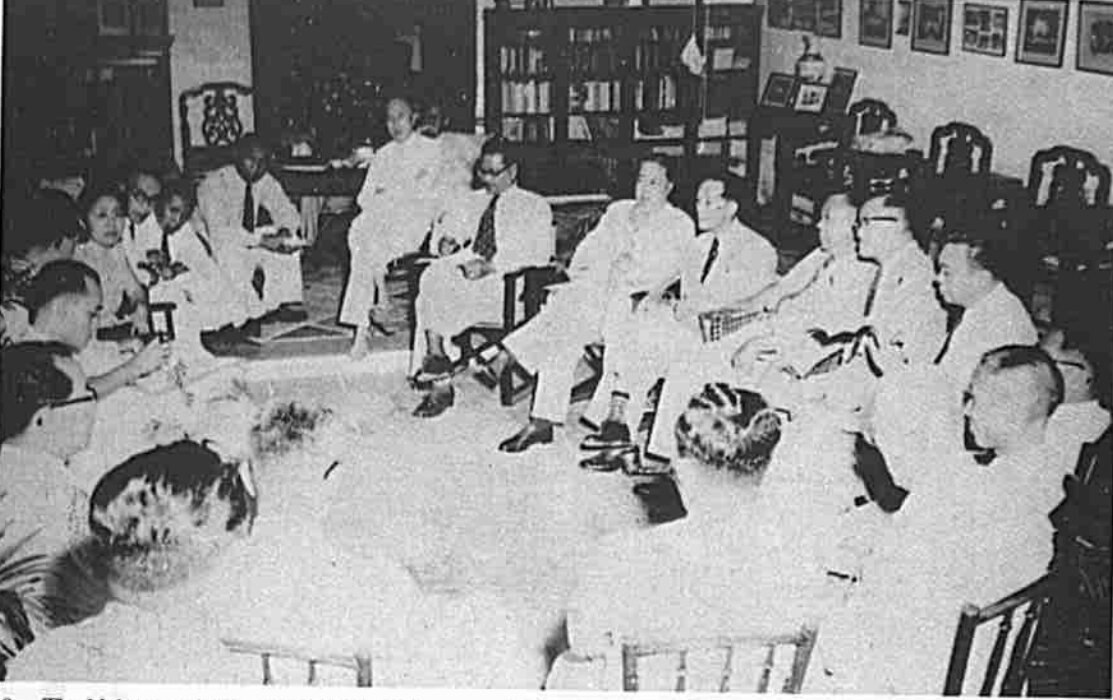
When the results came in on 27 July 1955, the numbers were starkly uneven.
The Alliance won 51 of the 52 seats. Based on TindakMalaysia's constituency-level data, the breakdown within the Alliance was: UMNO 34 seats, MCA 15 seats, MIC 2 seats. The one non-Alliance seat was won by PMIP — the precursor to PAS — in Krian, Perak. 2,1,3
The vote tallies are equally clear. TindakMalaysia's constituency-level data records total registered voters of 1,268,248, valid votes of 1,001,527, and Alliance votes of 818,013 — approximately 81.7% of valid votes cast. An article by Wong Chin Huat published by the Malaysian Bar summarises the same political outcome as approximately 1.28 million registered voters and an Alliance share of around 82%. The two sources agree on the broad picture, though their registered-voter figures are not entirely identical. 2,1,3
This discrepancy must be acknowledged openly.
The great danger in historical writing is to combine figures drawn from different methodological bases into a conclusion that looks more precise than it is. TindakMalaysia's constituency-level data includes the uncontested seat of Wellesley North, which is why the total registered-voter figure reaches 1,268,248; some summaries write approximately 1.28 million; other encyclopaedic sources give a lower "registered" figure, likely calculated only from constituencies where polling actually took place. This article treats this as a question of methodological scope, not a matter for conspiracy theories. 2,1,3
What does not change is the political conclusion:
The Alliance won by a landslide.
Onn Jaafar's Parti Negara received roughly 8% of the vote, yet won not a single seat. PAS received roughly 4% of the vote, yet secured the sole opposition seat. 1,2
This is not simply a matter of "who was more popular."
It is also a question of how the electoral system converts votes into power.
PAS's one seat cannot be reduced to a footnote#
Most accounts at this point mention only "the Alliance won fifty-one seats" and move on.
But that one seat must also be written.
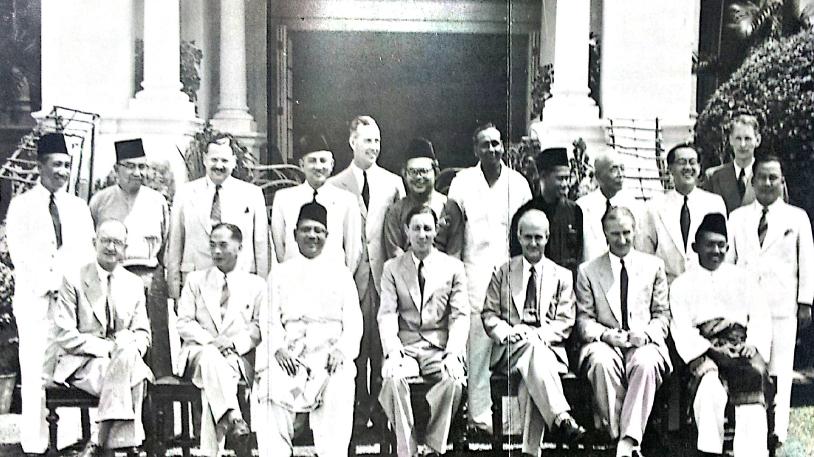
Krian, Perak, was won by PMIP, an outcome that later came to be cited as a founding moment in PAS's history. It did not alter the composition of the 1955 government, but it demonstrates that the challenge to the Alliance did not come only from the left, nor only from Onn's vision of a multiracial merged party. A religious-nationalist current had already surfaced at the ballot box. 2,1
This matters greatly for the subsequent trajectory of Malaysian politics.
Because the PAS question was never simply one of "opposition to UMNO."
It was also asking: how should the Malay and Islamic character of the state be arranged? Was the Alliance's constitutional compromise too secular? How should the citizenship, language, and educational space of non-Malays coexist with the political imagination of Malay Muslims?
In 1955, it held only one seat.
But one seat is not zero.
It shows that Malay politics before independence was never a single UMNO line. UMNO won the dominant position, but that did not mean other Malay Muslim political visions ceased to exist.
Why this election shaped the constitution#
This election did not directly write Article 153.
It did not directly write Article 152.
Nor did it directly determine Islam's place in the federal constitution.
But it decided something that came before all of those questions: who was entitled to bring those questions to London.
After the election, the Alliance government led by Tunku became the clearest local interlocutor in British eyes. Only then did the independence negotiations, the Reid Commission, the memoranda, the hearings, and the draft constitution unfold in sequence. The Reid Commission's report later recorded that the Commission held 118 hearings between June and October 1956 and received 131 memoranda. 1,6,3
Those hearings were certainly important.
But hearings do not take place in a political vacuum.
Who could organise a memorandum, who could persuade the British that they represented the major communities, who could secure the grudging acceptance of the sultans, the colonial government, and the electorate alike — these were the people who would carry the greater weight in the constitutional drafting process.
So the 1955 election was not the text of the constitution.
It was the doorway into the constitutional negotiations.
Representation is not the same as universal consent#
Here one must be careful.
To say simply "the Alliance won, therefore the constitution fully represents the people's will" is too crude.
To say simply "it was not a complete democracy, therefore the constitution has no legitimacy" is equally crude.
Malaya in 1955 was still under the Emergency. The logic of security had already compressed the political space for the left. Britain wanted a local government that could maintain order, resist communism, negotiate, and win elections. The CIA's 1949 assessment, though an external intelligence document rather than a neutral historical account, shows clearly that Cold War calculations and anti-communist security judgements had long been pressing down on Malayan politics. 4,1
At the same time, the electorate was restricted. The Malaysian Bar article notes that approximately 1.28 million voters were registered at the time, of whom 84.2% were Malay. This figure cannot be read as a simple proxy for national population ratios, and it reminds us that the mandate of 1955 was a mandate produced under a particular registration system and a particular electorate structure. 1,2
Yet these limitations do not erase the result itself.
Within that system, the Alliance did win.
It won decisively.
And it thereby obtained something very concrete in historical terms: the standing to negotiate.
The evidence behind this article — set out plainly#
The seat tallies and vote figures for 1955 have been cross-checked against at least two independent sources. TindakMalaysia's constituency-level CSV is the most granular dataset, enabling a seat-by-seat verification of Alliance 51 seats, PMIP 1 seat, Alliance total votes 818,013, and total valid votes 1,001,527. Wong Chin Huat's article published by the Malaysian Bar independently summarises the same political outcome: Alliance 51 of 52 seats, approximately 82% of the vote, PAS one seat, Parti Negara approximately 8% of the vote but no seats. ElectionData.MY / MECo serves as an independent electoral database background, confirming that this type of data covers elections from 1955 onwards and has undergone academic peer review. 2,1,3
There are methodological differences in the registered-voter figures. This article does not forcibly merge 1,268,248, approximately 1,280,000, and the lower registered figures found in some encyclopaedic sources. In the main text, the methodological reason is noted where relevant: TindakMalaysia's constituency-level total includes the uncontested seat; the Malaysian Bar uses a rounded figure. Conclusions are concentrated on the seat structure and vote-share percentages. 2,1
The formation of the UMNO-MCA-MIC Alliance has been cross-checked using the Malaysian Bar article and the H.S. Lee Private Papers index. The H.S. Lee papers in this context are primarily a newspaper clippings index rather than original newspaper texts; accordingly, this article uses them only to support the structural narrative of the coalition's formation and MIC's accession, not to manufacture detail about what was said at any particular meeting. 1,5
For the constitutional impact, this article uses the Reid Report as an anchor for the later section. The Reid Report demonstrates the commission's hearing and memorandum process, but cannot alone prove that the 1955 election "necessarily caused" any particular constitutional provision. This article therefore states only that the election determined the gateway into the negotiations — not that any individual clause was written by any individual ballot. 6,1
When using the CIA declassified document on the Emergency and Cold War background, this article maintains a critical distance. It is an American intelligence agency's assessment of the situation in Malaya, not a Malayan self-account; its value lies in showing how external powers perceived security, anti-communism, and local politics at the time — not in endorsing the conclusions of American intelligence. 4,1
Sources 6 Every important claim here can be checked. Open it and see.
Do not trust this site. Check it — every source below is clickable.
This site is written with AI assistance. Please check us.
AI can invent citations that look completely convincing — a real author's name, a plausible title, a sensible year, for a work that does not exist. This is not a theoretical risk; it is a known failure mode. That is why every source on this site is clickable. If a reference cannot be found anywhere, it may well not exist — and we want to know.
How to check us →
Reader Comments
Be the first to share your thoughts.