Who Is Muhyiddin Yassin? From UMNO Deputy to Pandemic Prime Minister after Sheraton
Johor Menteri Besar, deputy prime minister, Bersatu leader, eighth prime minister, and how a thin-majority government ruled during COVID-19
Muhyiddin did not suddenly appear in 2020.
He had spent a long time inside UMNO.
Johor, Menteri Besar, minister, deputy prime minister - these were the steps he had climbed. Today Parliament lists him as the MP for Pagoh, from PN; the Prime Minister's Office lists him as Malaysia's eighth prime minister, serving from 2020 to 2021.1,2
So he was not an outsider.
He was a man from the old system who later flowed back together with parts of that old system.
Leaving UMNO was not the same as leaving UMNO politics#
Muhyiddin's break with Najib, and his later role in Bersatu's formation, is often written as a political split over 1MDB.
That is part of the truth.
But Bersatu was not an ordinary reform party. From the start, it had a specific task: to give Malay voters who would not vote for DAP or PKR a path out of UMNO.2,3
That made Muhyiddin's position unusual.
He could tell Pakatan Harapan: without rural Malays, the turnover will not be stable.
He could also tell Malay voters: removing Najib does not mean handing over Malay political leadership.
In 2018, that bridge was useful.
In 2020, the bridge broke toward the other side.
After Sheraton#
Bersatu left Pakatan Harapan, Azmin's group left PKR, and Mahathir resigned. After the Yang di-Pertuan Agong assessed who was most likely to command a majority, Muhyiddin became prime minister.1,3
There was a constitutional procedure.
There was also a dispute over representation.
Because what voters authorised in 2018 was a Pakatan Harapan change of government; the government that appeared in 2020 came from a recombination of MPs, with support from UMNO and PAS, parties voters had removed from federal power.3,4
From the first day, Muhyiddin was not a prime minister with a thick majority.
He had to manage the pandemic, parliamentary numbers, UMNO pressure, Bersatu's survival, and PAS cooperation all at once.
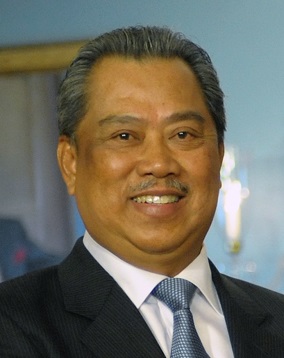
The pandemic prime minister#
The strongest memory of Muhyiddin's premiership cannot be separated from COVID-19.
Movement control orders, economic aid, vaccine rollout, pressure on hospitals, the rise in cases after the Sabah state election, and the 2021 emergency all happened during his term or were directly handled by his government.1,4
The pandemic was a real crisis.
The political crisis was real too.
Muhyiddin's difficulty was that the two overlapped. Supporters can say he kept administration running during an unprecedented health crisis. Critics can ask why public-health management had to reduce parliamentary scrutiny, and why a confidence vote kept being delayed.3,4
By August 2021, he resigned.
The majority was finally not enough.
The political inheritance he left#
Muhyiddin left behind more than a short-lived government.
He showed that after 2018, a Malaysian prime minister could change without a general election; parties could recombine inside an existing Parliament; a thin-majority government could use a national crisis to gain room; and voters would then demand anti-hopping laws, confidence votes, and clearer coalition mandates.
Sources 4 Every important claim here can be checked. Open it and see.
Do not trust this site. Check it — every source below is clickable.
This site is written with AI assistance. Please check us.
AI can invent citations that look completely convincing — a real author's name, a plausible title, a sensible year, for a work that does not exist. This is not a theoretical risk; it is a known failure mode. That is why every source on this site is clickable. If a reference cannot be found anywhere, it may well not exist — and we want to know.
How to check us →
Reader Comments
Be the first to share your thoughts.