Who Is Hadi Awang? PAS, Islamic Politics, and the Malay Political Centre
How a religious teacher, MP, and PAS president brought the mosque pulpit into the national power table
If you look only at parliamentary seats, you will underestimate Hadi Awang.
His politics did not begin in Parliament.
It first came from the pulpit.
The mosque in Rusila, rural Terengganu, religious classes, party branches, and campaign tents shaped his voice earlier than the parliamentary chamber did. The Parliament website today lists him as the MP for Marang, from PN, with a long string of titles before his name. But if we read him only from that line, we miss the source of his strength.1,2
His strength is not just a seat.
It is that many people believe he is explaining how politics should obey religion.
That is the core of the matter.
Hadi is not an ordinary politician who occasionally misspeaks.
Early in his career, he left behind a piece of political-religious language that later stayed like a nail in the doorframe of Malaysian politics. Its name is short: Amanat Hadi.
The long face of PAS#
Hadi became PAS president after 2002. ISEAS research describes him as one of the central faces of Malaysian political Islam in recent years, and notes that he shapes the political world of party members not only through speeches, but also through writing and party education.2,3
That is different from an ordinary party leader.
An ordinary leader talks policy.
Hadi talks worldview.
For supporters, that is his value: he makes PAS not merely a party contesting seats, but a movement with a religious direction. For critics, that is also the danger: when political difference is religiously framed, opponents can be cast not merely as people who disagree, but as people standing on the wrong side.2,3
Amanat Hadi: when political opponents enter the boundary of faith#
In 1981, Hadi gave a speech in Banggol Peradong, Terengganu, later known as Amanat Hadi.
This was not an ordinary campaign speech.
Ahmad Fauzi Abdul Hamid, writing on Islam and violence, places it in the context of Malaysian political Islam, takfir, and the Memali incident. The dispute centres on how Hadi connected support for UMNO/BN with maintaining a colonial-style constitution and failing to implement Islamic rule; language of that sort can easily turn political competition into a judgment of faith.4,5
Supporters may say it was a political-theological critique of a specific era.
The problem is that ordinary members and rural listeners may not hear only "institutional critique".
They may hear this: the person on the other side did not merely vote for the wrong party; he stood in the wrong place before faith.
That is the danger.
In democratic politics, an opponent should simply be an opponent.
Once he is religiously marked, he can become a traitor, a deviant, or someone no longer entitled to normal treatment.
Memali cannot be written simply as "one speech caused violence". That would be too crude, and unfair.
But language also cannot be cut away from consequence. Ahmad Fauzi's study discusses Amanat Hadi, PAS radicalisation, the state's security response, and Memali's bloodshed within one historical chain; Hadi's later remarks about Amanat Hadi also show that it was not just an old sentence that had vanished from politics. At minimum, it shows this: religious political language is not weightless rhetoric. It enters villages, pulpits, families, and scenes where police and citizens face one another.4,5
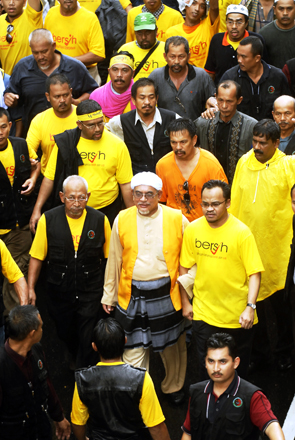
From state power to the national table#
Hadi was once Menteri Besar of Terengganu and has long represented Marang. PAS often travels nationally from the states: Kelantan, Terengganu, then Selangor, Kedah, Parliament, and coalition negotiations.1,3
That makes PAS unusual.
It does not only speak about Islam on television.
It manages land, welfare, local administration, and religious institutions in state government.
So when PAS entered PN, worked with Bersatu, and after 2022 became one of the largest single parties, Hadi was no longer a marginal opposition voice. He represented a political machine with state experience, religious grassroots, and Malay rural networks.1,2,3
Terrorism allegations: false material cannot be used as a weapon#
This must be said clearly.
PAS and Hadi may be criticised, and sharply.
But unproven "terrorism links" cannot be used against him.
In 2004, Britain's Daily Mirror wrongly described Hadi as connected to terrorism. The paper later apologised publicly and paid damages. Carter-Ruck's public record says the report was wrong and defamatory; KUNA also reported that Hadi accepted libel damages.6,7
So this site does not write "Hadi is linked to terrorist organisations."
That is not a defence of him.
It is the opposite: serious criticism does not need false material.
The public, long-term, checkable political-religious line is already enough to question: the language of Amanat Hadi, PAS's tension with plural constitutionalism, and how he turns "who represents true Islam" into a tool of mobilisation.2,3,4,5
GISBH: questions are fair, but evidence cannot jump levels#
In 2024, children's homes linked to GISBH were investigated in large police operations. Media reports described allegations involving child abuse, exploitation, forced labour, and religious-style control. Local and international media reported police rescues of children and arrests of suspects. Those allegations are serious enough; they do not need an unproven political conspiracy added on top.
The question is: is there a clear organisational link between GISBH and PAS?
At present, public material does not allow this site to write that there is.
On 17 October, Borneo Post, citing Bernama, reported that the Home Ministry told Parliament in a written reply that there was no solid evidence linking political leaders or government officials to GISBH. That reply does not mean there will never be a problem, and it does not mean every social question has been answered. But it is enough to remind us that "belonging to the same conservative Malay-Muslim social world" cannot be written directly as "PAS network".
What can be written is PAS's political reaction.
After the GISBH controversy, FMT reported that PAS urged the government not to act excessively against GISBH and argued for separating alleged criminals from the business network. That position itself deserves scrutiny: when a religious business network is accused of involving child victims, unpaid labour, and mental control, why was PAS's first instinct not to put victim protection at the front, but to warn the government not to go too far?
That is the point of criticism.
Not forcing GISBH into PAS.
But asking why similar cases can so often receive political sympathy in conservative religious communities in the form of "do not hit too hard first". Why are children, women, and lower-ranked members so often seen more slowly than the dignity of religious organisations?
The question he leaves behind#
Hadi made PAS steadier.
He also made Malaysia harder to avoid one question: how can a plural country hold Islamic politics, constitutional citizenship, non-Muslim security, and East Malaysian secular political traditions at the same time?
That question cannot be solved by laughing at PAS for being conservative.
It also cannot be ended by saying "the Muslim majority agrees."
It must return to institutions: where the legal boundary lies, where state power lies, how the Federal Constitution protects all citizens, and whether a party can win Muslim votes without writing other citizens as threats.
Sources 7 Every important claim here can be checked. Open it and see.
Do not trust this site. Check it — every source below is clickable.
This site is written with AI assistance. Please check us.
AI can invent citations that look completely convincing — a real author's name, a plausible title, a sensible year, for a work that does not exist. This is not a theoretical risk; it is a known failure mode. That is why every source on this site is clickable. If a reference cannot be found anywhere, it may well not exist — and we want to know.
How to check us →

Reader Comments
Be the first to share your thoughts.