Who Is Najib? Tun Razak's Eldest Son and the Forty-Year Road to Succession
Into Parliament at twenty-three, Menteri Besar at twenty-nine, then prime minister in 2009; how political inheritance shapes a person
In 2016, Najib was asked about his father.
He did not begin with the New Economic Policy. He did not list the institutions Tun Razak had left behind. He remembered something smaller: even on holiday, his father still gave most of his time to work; villagers who came to see him would still receive attention. Najib said his father repeatedly told him during his school years to study hard, and if possible, be first in class. 1,2
This was Najib's own memory, not someone else's verdict on his character.
But it shows how he liked to tell his own story: not as a man waiting to inherit, but as a man who had to prove he deserved his father's name.
The Ballot at Twenty-Three#
In 1976, Tun Razak died while in office. Najib then won the Pekan by-election in Pahang uncontested and entered Parliament at the age of twenty-three. At twenty-five, he entered government as a deputy minister. At twenty-nine, he became Menteri Besar of Pahang. 1,2
This was a road almost no ordinary political newcomer could copy.
He had a British education and a background in industrial economics. He had also spent a short time in business and public institutions. But what sent him straight into the heart of Parliament was the seat, reputation, and national mourning left behind by his father's death. 1,2
Admitting this does not deny the forty years of political experience he later accumulated.
In the same way, listing forty years of experience cannot pretend that the first door was open to everyone.
He Was Waiting, But Not Standing Still#
From Menteri Besar of Pahang, to culture, youth and sports, defence, education, and then deputy prime minister, Najib climbed nearly every major rung of the UMNO government ladder. 1,2
In 1984, a TIME journalist who interviewed him saw a young Menteri Besar with a British education, a calm manner, self-confidence, and an air of political aristocracy. The writer already guessed that he might one day lead the country. 2,3
Twenty-five years later, the guess became true.
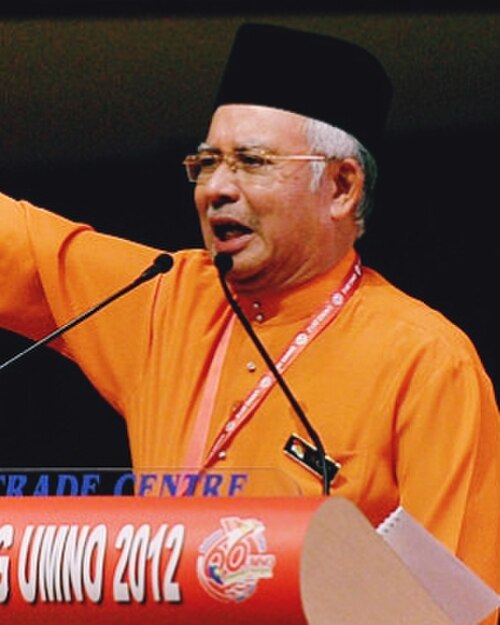
On 3 April 2009, Najib was sworn in as Malaysia's sixth prime minister. In his speech that day, he thanked Abdullah and tied his public mission directly back to his father: ending poverty, restructuring society, and widening educational opportunity. 2,4
Here we should pause.
Tun Razak's name gave Najib more than a halo. Because Najib himself used his father to explain his mission, every later failure of national institutions and every case of public money with no clear accountability could also be judged against that same standard of "service to the people".
A Life Cannot Be Judged Backwards#
After knowing the ending of 1MDB, it is easy to write all forty years of Najib's career as a straight road to scandal.
That makes history simpler. It does not make it more accurate.
In 2009, voters had not yet seen the United States Department of Justice asset lists. They saw a new prime minister with deep experience, quick movement, and the promise of "People First, Performance Now". They also saw several decisions he made on his first day that could be observed immediately. 2,4
To judge Najib, we must first let these early promises appear in full.
Then we can ask how he used the power in his hands.
Sources 4 Every important claim here can be checked. Open it and see.
Do not trust this site. Check it — every source below is clickable.
This site is written with AI assistance. Please check us.
AI can invent citations that look completely convincing — a real author's name, a plausible title, a sensible year, for a work that does not exist. This is not a theoretical risk; it is a known failure mode. That is why every source on this site is clickable. If a reference cannot be found anywhere, it may well not exist — and we want to know.
How to check us →Reader Comments
Be the first to share your thoughts.