The King from Across the Strait
An Indonesian actor said \"without Indonesia, there would be no Malaysia\". Tone aside, the sentence holds three true pieces of history, and three places where they were stitched wrongly
In early October 2026, a football meme set netizens in two neighbouring countries alight.
After Indonesia won the ASEAN Cup, the official account of the Indonesian skincare brand Kahf posted a football meme that many Malaysian netizens read as belittling their neighbour. The brand later deleted the post and apologised, but the boycott on Malaysian social media had already begun. 1,2
A few days later, the Indonesian actor Boy Hamzah answered the boycott on social media. According to Malaysian media reports, the gist of what he said was this: the Malacca Sultanate was founded by Sultan Iskandar Shah, who originally came from Sumatra; had he not come to the peninsula, Malaysians today would not be what they are — "korang (Malaysia) tak akan pernah ada (wujud) tanpa Indonesia". 1,2
His original words were also laced with a few condescending jibes, which are not repeated here. This site has also not found the original in Indonesian: the sentence above is the media's Malay transcription, and accounts of which platform he used differ. 1,3
One Sentence, Three Centuries#
Let us set the tone aside first.
If we treat the sentence as a serious historical question — "did the royal houses and the state of Malaysia come from the land that is Indonesia today?" — it deserves a serious answer. The answer is half "yes" and half "no", and the "yes" half is larger than what he actually said.
It is worth saying plainly what this piece does not do. It only recounts how the sources record the origins of several royal lines. It does not comment on any ruler today, and it does not keep score for any country.
Think of it as a jigsaw puzzle: Boy Hamzah holds one genuine piece, but he forces it together with another piece and then declares the whole picture to be his family's.
The First Piece: Palembang#
The founding story of Malacca does point across the strait.
The Portuguese apothecary Tomé Pires, in the Suma Oriental written between 1512 and 1515, says that Malacca's founder Parameswara was a prince of Palembang who fled to Temasek and then settled in Malacca. 4,5 What the Ming Shilu (Veritable Records) records is a king of Malacca named "Bai-li-mi-su-la" (Parameswara), whom the Ming court invested in 1405. 5,4
The Malays' own court chronicle, the Malay Annals (Sejarah Melayu), likewise places the origin of the royal line in Palembang. 6,4 In its account, three princes descended onto Bukit Si-Guntang in Palembang.
So the piece Boy Hamzah is holding is real: the tradition of Malacca's royal line begins in Sumatra.
The First Mis-stitch: Two Stories Made One#
But here we need to pause.
The story in the Malay Annals and the story in Pires are not the same story. In the Malay Annals, the one who set out from Palembang is the distant ancestor Sang Utama, later called Sri Tri Buana, who founded a kingdom in Singapura; Iskandar Shah is the son of Singapura's king, Paduka Sri Maharaja — he is a king of Singapura who, after Majapahit sacked it, fled south and reached Malacca by way of Muar.
According to the Malay Annals, Iskandar Shah himself did not flee from Palembang. That "he himself came from Palembang" is the version from Pires's line of tradition.
Boy Hamzah has stitched two narratives into one: the names from the Malay Annals, with the route from the Portuguese. This is not unusual — in the article "The Man Who Escaped", this site has written that scholars still have no settled answer to whether Parameswara was Iskandar Shah.
There is one more detail, and it is a more interesting one. In the same chapter of the Malay Annals, Sang Sapurba, the eldest of the three princes, is invited by the Minangkabau to be installed as their king. In the imagination of this Malay court chronicle, the royal line of Malacca and the royal line of Minangkabau were brothers from the start.
The Second Mis-stitch: There Was No "Indonesia" Then#
The second is more basic.
Fifteenth-century Palembang was not "an Indonesian city". There was no country called Indonesia then, and no country called Malaysia. Palembang, Minangkabau, Temasek and Malacca were different ports and kingdoms on the same sea, joined by the monsoon and the sailing routes.
The name "Indonesia" itself was only proposed in 1850 by the Englishman George Windsor Earl — and when he proposed it he offered another name at the same time, "Malayunesians", and himself chose the latter. Only afterwards did another British scholar, James Richardson Logan, bring "Indonesia" into use. It was the Youth Pledge of 1928 and the Proclamation of Independence in 1945 that made the name that of a nation and a state.
So to say "Parameswara came from Indonesia" and to say "Parameswara was a Malaysian" make the same mistake: drawing today's national borders back onto an age that had none.
The Third Piece: What He Did Not Mention#
Interestingly, what Boy Hamzah left out is more solid than what he said. This is not a criticism that he overlooked it — he never claimed it — but if the question is pursued seriously to the end, the answer extends in three directions.
The Bugis. In 1699 the Sultan of Johor was assassinated and the royal line was broken. Around 1717 to 1718, Raja Kecil, who claimed to be a prince and brought Minangkabau followers, seized Johor; the displaced family appealed to the Bugis from Sulawesi, and in 1722 Malays and Bugis together drove Raja Kecil back. 7,8 Afterwards, a Bugis chief took a newly created office, the "Yang Dipertuan Muda", which shared power with the Johor royal house. 7,8
Raja Lumu, the first Sultan of Selangor, was a descendant of these Bugis chiefs, and was installed by the Sultan of Perak. 8,9 Older scholars reckon the year of installation at about 1780; the later mainstream version is 1766 — the modern scholar Barbara Watson Andaya has a paper titled "The Installation of the First Sultan of Selangor in 1766".
One more point: according to an academic article on the University of Malaya's economic history website, the "Bugis" here soon became a blend of Bugis descent, Malay language and Malay culture. They were not envoys sent by any state.
The Minangkabau. The royal line of Negeri Sembilan comes from the Minangkabau royal house, and the prince was invited by local chiefs, not brought in by invasion. 10,9 The local account recorded by a British official in 1898 is that the chiefs went first to Johor, passing through Siak, and then on to Minangkabau to "invite a king", and an old saying among the people goes: "Beraja ke Johor, bertali ke Siak, bertuan ke Minangkabau". Tradition names this prince Raja Melewar, installed in the 1770s; this site has read his name and the year in only one secondary source.
The Acehnese. This one runs the other way, and is the least often mentioned. In the early seventeenth century, Iskandar Muda, the Sultan of Aceh in northern Sumatra, sent fleets to attack Pahang, Kedah and Perak — according to a Leiden University doctoral thesis, between 1617 and 1620. But earlier still, in the second half of the sixteenth century, a Perak prince had been installed as Sultan of Aceh. 11,8
So people and crowns flowed both ways across this sea: some came to the peninsula from Sumatra and Sulawesi, and some went from the peninsula to Sumatra; some were invited, some invaded, and some were driven out together.
The Third Mis-stitch: A State Is Not a Family Tree#
The last has nothing to do with ancestors.
The state of "Malaysia" was formed in 1963. It was put together by a constitutional procedure: an agreement among four parties — Malaya, Singapore, Sabah and Sarawak — together with a United Nations team confirming the wishes of the people of North Borneo and Sarawak. Section 10 of the Manila Accord of July 1963 states that the Philippines and Indonesia, once the United Nations had ascertained the wishes of the people there, "welcomed" the formation of Malaysia.
As it turned out, the Indonesian government of the time did not welcome it. From 1963 to 1966 Indonesia waged "Konfrontasi" against Malaysia. 12,2
So the sentence "without Indonesia, no Malaysia", set in the context of 1963, happens to be the reverse of what occurred: Malaysia was formed amid Indonesian objection.
Who Drew the Line#
Then who drew today's border?
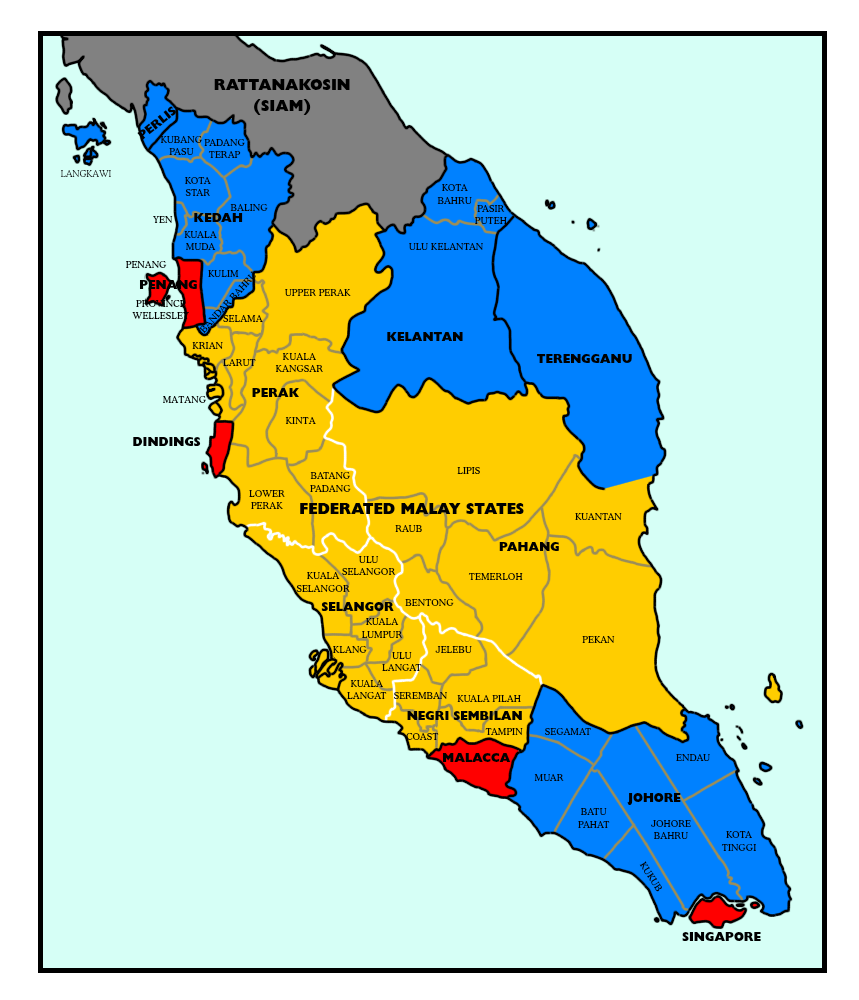
In 1824, Britain and the Netherlands signed a treaty in London. It handed Malacca to Britain, handed Britain's Sumatran posts to the Dutch, and the Dutch also withdrew their protest against the British occupation of Singapore. 13,14 The text of the treaty does not mention Johor or Riau by a single word; but it divided the spheres of influence north and south of the strait between two powers, and the Johor–Riau kingdom, once a single whole, was cut in two from then on. 13,14
This line was not drawn by the Malays, nor by the Indonesians. The people on either side could afterwards only grow up on their own side of it.
The Old Pattern: Who Owes Whom#
This is not the first time.
In 2009, a television advertisement promoting Malaysia used Pendet dancers from Bali. According to The Jakarta Post's report that August, Indonesia's culture and tourism minister protested publicly; a spokesman for Indonesia's foreign ministry said it was "highly unlikely" that Malaysia wanted to claim the dance as its own, and urged both sides not to be emotional.
That time, Malaysia was accused of "taking" something belonging to Indonesia; this time, Malaysia is accused of "owing" Indonesia. The direction is opposite, the shape the same: two neighbours sharing one sea of culture, each treating the same heritage as its own private property.
Limits of the Evidence#
- Boy Hamzah's original words: this site has not found the Indonesian original or the original post; there are only Malay and English retellings by Malaysian media, and the platform has not been confirmed.
- Whether he apologised or clarified: not seen in the public record.
- Details of the Kahf controversy: the two reports this site read give only a rough account, and the page of another, more detailed report could not be opened.
- Raja Melewar's name and year of installation: this site has read them in only one secondary source.
- Year of Raja Lumu's installation: Wilkinson (1923) reckons about 1780; the 1766 dating comes from Barbara Watson Andaya's 1974 paper, and this site has verified only that the paper exists, without reading its text.
- Aceh's 1617–1620 campaigns: this site relies on a single thesis, Mitrasing 2011. For the Perak prince who became Sultan of Aceh there are two sources, but both may derive from Aceh's Bustan as-Salatin, so their independence is in doubt.
- The origin of the word "Indonesia" and the original text of the Youth Pledge: what this site has read are chapters of academic books and encyclopaedia summaries, not yet a primary text, so the body carries no citation markers.
- Origins of the royal lines of Pahang, Kelantan and Perlis: not checked in this round.
- Single-source claims named directly in the text: Section 10 of the Manila Accord (this site read a transcription of the treaty text), the 2009 Pendet controversy (The Jakarta Post), the blending of the Bugis with Malay culture (an article on the University of Malaya economic history website).
Boy Hamzah's video circulated on Malaysian social media for a few days, and was then drowned out by the next topic.
Yet Bukit Si-Guntang is still in Palembang, and the tide at the mouth of the Melaka River still rises twice a day. What the two sides are quarrelling over is in fact the same Malay Annals — only few people have read it from beginning to end.
Note: at the time of writing (October 2026), this site has not found the Indonesian original of Boy Hamzah's post, nor any public clarification from him. If you have a more accurate original source, please write to correct us.
Sources 14 Every important claim here can be checked. Open it and see.
Do not trust this site. Check it — every source below is clickable.
-
Search for this source ⌕ no direct link — this button searches for the work 2026-10-11 Report this source
-
Search for this source ⌕ no direct link — this button searches for the work 2026-10-11 Report this source
-
Journalism World of Buzz, 'Indonesian Influencer Sparks Outrage After Mocking Boycott Calls…', Oct 2026Search for this source ⌕ no direct link — this button searches for the work 2026-10-11 Report this source
This site is written with AI assistance. Please check us.
AI can invent citations that look completely convincing — a real author's name, a plausible title, a sensible year, for a work that does not exist. This is not a theoretical risk; it is a known failure mode. That is why every source on this site is clickable. If a reference cannot be found anywhere, it may well not exist — and we want to know.
How to check us →
Reader Comments
Be the first to share your thoughts.