The Death of an Englishman
Textbooks say Birch violated Malay custom; but inside that 'custom' lay debt bondage, fugitive slaves, power, and ordinary people's lives
An Englishman died on the bank of the Perak River.
Later, many Malaysian students would read about this in their textbooks: J.W.W. Birch was too aggressive, arbitrarily collected taxes, interfered with Malay custom, and was killed as a consequence.
None of that is untrue.
But it is too brief.
Brief enough to conceal the most painful layer.
The Question Rafizi Asked#
In August 2026, Rafizi Ramli discussed Birch in a public video. He began by laying out the standard textbook account: what schools teach is that Birch collected taxes, behaved disrespectfully, and violated adat. Then he paused and reminded his audience that history ought to be read according to fakta dan sumber — facts and sources. 1,2
The host then asked: when we say Birch violated Malay custom, what custom exactly are we talking about?
Rafizi's answer was brief at its core: amalan penghambaan — the practice of enslavement.
He was not saying that the British colonisers had suddenly become angels.
He was reminding us that what was packaged as 'custom' at the time was, in part, the system of slavery and debt bondage. The Hansard of the British Parliament from 1876 similarly placed Perak's debt slave problem on the same table as the conflict surrounding Birch's death. 1,2
This is where this article begins.
Not to whitewash the British.
Nor to compose a eulogy for any side.
But to press the question to its conclusion: if a man was killed because he touched a 'custom', we must ask — whose interests did that custom protect?
The Door the Treaty Left Open#
Let us return to 1874.
Article VI of the Pangkor Treaty stipulated that the Sultan of Perak must receive a British Resident. This Resident's advice must be sought, and must be acted upon, in all matters — save one: Malay religion and custom. 2,3
This clause looks like a concession.
The British took away fiscal authority, administrative power, and real control, but left open one door through which the Sultan and the pembesar could still say: this is territory you may not touch. 2,3
The problem was that nineteenth-century Perak's 'custom' was not a clean cultural postcard.
It contained ceremony.
It contained dignity.
It contained the order of rule.
And it also contained debt bondage, fugitive slaves, forced labour, and the local elite's dominion over people.
So when Birch arrived in Perak, the conflict was not simply 'an Englishman lacking manners'. That certainly existed. The Hansard contains members of Parliament criticising him as unsuited for the post, ignorant of the Malay language, his conduct itself inflaming the situation. Swettenham's memoirs likewise show that Birch's arrival unfolded against a backdrop in which a succession dispute, secret society warfare, tax reorganisation, and British commercial interests were all tangled together. 2,3
But to focus only on his abrasiveness is to miss something else.
What he touched was not abstract culture.
What he touched was a system from which certain people derived income, status, and control over other human beings.
'Debt Slaves'#
On 26 May 1876, the British House of Commons debated the killing of Birch.
The Hansard is not a neutral people's record. It is the record of the British imperial parliament, and much of what was said there carries the lens through which colonisers viewed the Malay Peninsula. That bias must be placed on the table when reading it. 2,3
But bias does not equal absence of material.
Sir Charles Dilke stated in the debate that Britain had found itself in the Malay Peninsula in the same kind of difficulty it had once faced on the Gold Coast: in the so-called protected territories, Britain had in effect extended a degree of sanction to slavery. He went on to say that from Captain Speedy's reports and correspondence forwarded to the Colonial Office, it was evident that there was a great deal of slavery in the Malay territories. Speedy had stated that a large proportion of the population consisted of debt slaves; Dilke added that whatever they were called, in substance they were slaves. 2,4
These words carry weight.
Because this is not someone in the twenty-first century applying retrospective moral standards.
This is 1876 — within seven months of Birch's death — British members of Parliament acknowledging in the House of Commons that the problem of debt bondage had a material bearing on the situation that led to Birch's killing. 2,3
The Hansard does not say 'Birch died solely because he opposed slavery'.
That cannot be overstated.
Birch's death involved multiple causes: taxation, succession, the authority of the Resident, the posting of proclamations, the humiliation of local chiefs, British encroachment, and his own methods of governance. 2,3
But debt bondage and slavery were present within this conflict.
They were not a political interpretation forced in afterwards.
Whose Custom#
Pause here for a moment.
The phrase 'violated Malay custom' sounds as though it describes protection of a community.
But nineteenth-century Perak was not a community of equals gathering to decide adat together. It was a world with a Sultan, with raja, with pembesar, with ordinary kampung people, with debt slaves, with people who fled and were pursued and returned, and with Orang Asli communities who were raided, sold, and driven ever deeper into the forest. 2,5,6
To a pembesar, certain debt bondage relations may have been property.
To the person bound by debt, it was freedom taken away.
To those who had fled, being brought back was not 'the restoration of custom' — it was one's body returning into another person's possession.
For Orang Asli communities, the history of enslavement extends far beyond the story of one British official on the Perak riverbank. Semai place names, whetstones, and oral histories document the Prak Sangkiil / Rawa Malay slave raids; Btsisi'/Mah Meri ethnohistory preserves memories of dispossession, the enslaving of children, and the killing of kin; colonial ethnography, for all its considerable bias, likewise records that Orang Asli were raided and enslaved. 5,6,7
This thread is covered in two separate articles on this site:
The People Taken from the Forest
Those Who Left Their Names Behind
Those two pieces concern the place names, caves, leaders, women, shamans, and escape routes that Orang Asli communities themselves left behind.
This article concerns Birch.
But the two threads meet at one point: when power calls people property, a history textbook that writes only 'custom' has already spoken on power's behalf.
Birch Was No Saviour#
The other side of the ledger must also be written clearly.
Birch was not a fairy-tale abolitionist hero.
He was a British colonial official.
The Pangkor Treaty was not a people's mandate for reform. It was the vehicle through which Britain — exploiting Perak's succession crisis, the Larut mining conflicts, and the commercial interests of the Straits Settlements — inserted the Resident system into the Malay states. In the Hansard debates, multiple members of Parliament discussed not only 'protecting the people' but also British commercial interests, tin, the fiscal burden on the Straits Settlements, and whether Britain had already slid into de facto annexation. 2,3
When Swettenham later recorded the Pangkor Treaty, he was not a detached historian. He was himself the officer who had been sent to Larut to convey a message in January 1874 on the orders of Andrew Clarke; he was in the same flotilla as Birch when Birch was killed in November 1875; he would later rise to become the highest authority of this very system. 3,2
So this history cannot be written as:
The British came to rescue the people, and the locals came to obstruct civilisation.
That is the coloniser's favourite story.
But neither can it be written as:
Local elites killed a British official, therefore they automatically represented the people.
That is another lazy story.
The genuinely difficult question lies between: the colonisers entered with their own interests; the local rulers had their own interests to defend. Ordinary people — particularly debt slaves, fugitives, raided Orang Asli, and kampung folk crushed beneath taxation and warfare — were rarely granted a seat at the negotiating table. 2,5,6
The Day at Pasir Salak#
On 2 November 1875, Birch was killed at Pasir Salak. Swettenham later wrote that on 4 November, while sailing down the lower Perak River, he received the news: Birch had died on 2 November at the hands of Maharaja Lela's men, and trouble had also broken out at Bandar Bharu, with the river blocked. 3,2
Beyond this, the details require caution.
Different records diverge on the scene, the weapons, and the immediate confrontation. This site will not reconstruct a cinematic sequence that no eyewitness account can fully support.
We hold to two things that the evidence establishes.
First, Birch did die.
Second, his death was subsequently used by the British to launch a military campaign. Maharaja Lela and others were executed, Sultan Abdullah was exiled, and the Resident system did not retreat — it took root in a more cautious, more deeply embedded form. 2,3
That is the cruelty of history.
A colonial official died.
A local chief was hanged.
A Sultan was banished.
And those who had long been crushed beneath debt bondage and slavery gained no historical page of their own as a result.
Reading from the People's Vantage Point#
Reading this episode from the people's vantage point is not a matter of asking 'were the British good or bad?'
The British Empire was certainly no charitable institution.
Reading from the people's vantage point is also not a matter of asking 'was Maharaja Lela a hero?'
That question returns us too quickly to elite history: one British official, one local chief, one Sultan, one empire.
The people's vantage point asks a different set of questions.
Who, within that 'custom', held the power to indebt another person into losing their freedom?
Who held the power to pursue and retrieve those who fled?
Who could place Orang Asli children, women, and men into networks of exchange?
Who, after the British arrived, was registered, taxed, relocated, conscripted, and punished — yet was never asked whether they wanted this new order?
If we remember only 'Birch interfered with custom', we are reading a truncated history.
If we remember only 'the British abolished slavery', we are reading the history the colonisers wrote for themselves.
If we remember only 'Maharaja Lela killed an Englishman', we are reading the history of a commemorative monument.
But if we ask: before that blow fell, who was enslaved? After that blow fell, who was more free?
That is when we begin to approach the people's history.
The Evidentiary Boundaries of This Article#
Rafizi's remarks come from a public YouTube Short published in August 2026. This site retrieved the Malay subtitles, but treats them only as a record of Rafizi's public statements; they are not a primary source for nineteenth-century historical facts. 1,8
The killing of Birch and the Pangkor Treaty rely principally on Hansard 1876 and Swettenham 1907. Both are British-side materials, not a neutral set of scales; this article has incorporated British commercial interests, colonial expansion, and the authors' personal stakes into the main text. 2,3
Whether debt bondage and slavery were present within the conflict — the Hansard of 1876 is the hardest piece of evidence used here: in a British parliamentary debate held shortly after Birch's death, it placed the question of slavery and debt slaves in the Malay territories alongside the situation surrounding that death. This article does not present debt bondage as the sole cause. 2,4
The raiding of Orang Asli into slavery is not the primary thread this article develops; the article draws on Heikkila 2016, Nowak & Muntil 2004, and Skeat & Blagden 1906 only to establish that this background thread demonstrably exists — the details are covered in two dedicated articles on this site. 5,6,7
Cilisos is a popular reporting outlet, cited only to note that this episode has also entered mainstream public discussion; this article does not rest any claim on it alone. 4,2
This article is marked sensitive: true. Before publication, every sentence touching on Malays, adat, pembesar, Orang Asli, slavery, debt bondage, Birch, Maharaja Lela, and British colonialism must be reviewed line by line by the editor.
In the next article, the colonisers no longer merely write treaties. They begin to count people.
Sources 8 Every important claim here can be checked. Open it and see.
Do not trust this site. Check it — every source below is clickable.
-
View excerpt ↓
That the Sultan receive and provide a suitable residence for a British Officer, to be called Resident, who shall be accredited to his Court, and whose advice must be asked and acted upon in all questions other than those touching Malay religion and custom.
-
View excerpt ↓
by which men and women of the country of the Sakkais or wild people of the interior are captured after being hunted down, and are then sold, and made slaves.
This site is written with AI assistance. Please check us.
AI can invent citations that look completely convincing — a real author's name, a plausible title, a sensible year, for a work that does not exist. This is not a theoretical risk; it is a known failure mode. That is why every source on this site is clickable. If a reference cannot be found anywhere, it may well not exist — and we want to know.
How to check us →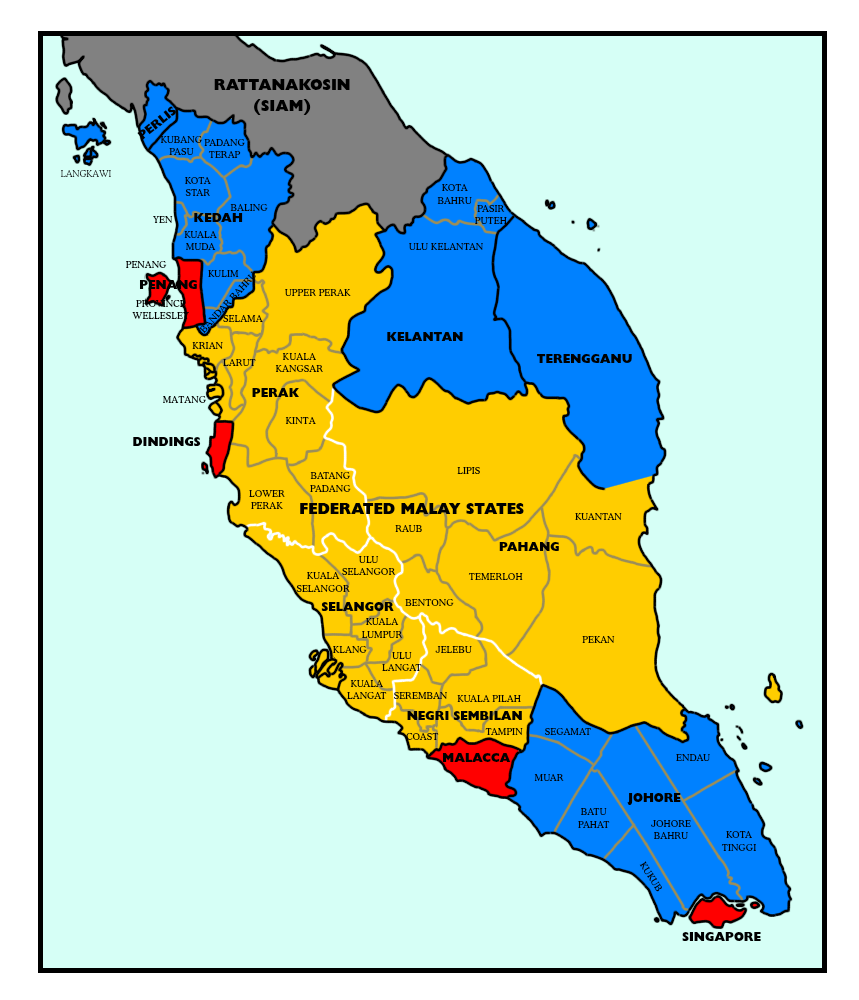
Reader Comments
Be the first to share your thoughts.