The People Taken from the Forest
The history of Orang Asli enslaved through slave raids — a history that should not survive only in place names, whetstones, and other people's footnotes
Some histories have no monuments.
They survive in place names.
A river mouth, a stone, a name that an elder pauses over when he speaks it. An outsider passes through and sees only forest; those who live there know it is no ordinary path. It is a path that someone once escaped along.
In Semai memory there is a name: Prak Sangkiil. Heikkila's research translates this as the Rawa Malay slave raids. What she studied was not palace archives, but Semai place names, whetstones, and oral histories. Those names point to something that official histories have long passed over lightly: that Orang Asli settlements were raided for slaves. 1,2
This is not a subject suited to slogans.
Because the moment a sentence is written carelessly, it becomes another act of harm.
Getting the words right#
This article does not argue that Malays are inherently one way or another.
Nor does it claim that all Malays did the same thing.
What the historical sources point to is something more specific: around the nineteenth century, certain Orang Asli communities on the Peninsula — in particular the Semai, Sakai/Senoi, Btsisi'/Mah Meri, and Mantra/Temuan — were subjected to abduction, killing, and enslavement by local Malay chiefs, intermediaries, and armed groups from the Malay world such as the Rawa, Mandailing, and Batak, who originated in Sumatra and subsequently operated throughout the Peninsula. 1,2
In Orang Asli memory, these groups are often gathered under the term gap — meaning "Malay / outsider Malays." Heikkila is careful to note that this category encompasses both local Malays and Austronesian-speaking peoples from Sumatra such as the Rawa, Batak, and Mandailing. 1,2
Who were the Rawa?
In these sources, Rawa refers to an Austronesian-speaking, Malay-world group who originated in central Sumatra and subsequently migrated to several states on the Peninsula. Heikkila, citing Milner's research, notes that the Rawa were associated with the Padri movement and were also known as Rinchi or Kerinchi; from the late 1820s onwards they were recorded in Melaka, Negeri Sembilan, Perak, and Pahang. Some Rawa were engaged in gold mining and rice cultivation in Perak and Pahang; others were employed as mercenaries by local Malay chiefs, and left a reputation for raiding and disrupting local order. 1,2
This article's references to the Rawa, therefore, do not concern all those who today identify as Melayu Rawa.
They concern the armed raiders documented in nineteenth-century sources and in Orang Asli memory.
The criticism in this article, then, is not directed at any ordinary Malay family today.
It is directed at a history of power: who had guns, who had chiefs, who had markets, and who could turn another person's child into a commodity.
Those whetstones#
The title of Heikkila's article contains a very concrete word: whetstones.
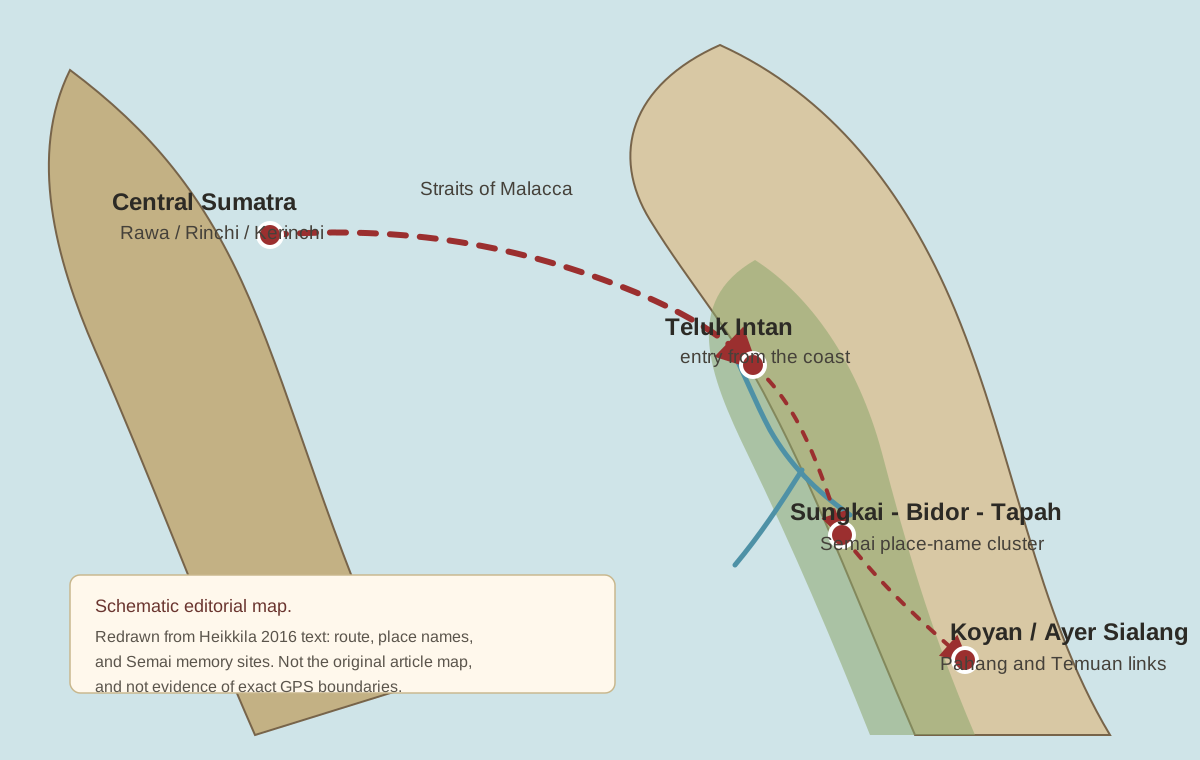
In the Semai place-name system, certain stones are recorded as places where the Rawa stopped to sharpen their blades. Path names, stream names, rock names — they pin the raiding routes into the forest. The materials she recorded say that the Rawa entered Semai territory from downstream; along the way some people fled, some resisted, and in some places only a name was left behind. 1,2
This kind of evidence is unlike dynastic chronicles.
It carries no regnal year.
No royal seal.
No edict dated to a particular year and month and day.
But it has another kind of force: a community embeds a catastrophe in a place name and passes it down generation after generation. As long as that stream still bears that name, children will ask: why?
Heikkila argues that these place names, whetstones, and narratives are the Semai's own way of preserving history from their own perspective. They are not decorative folklore, but the historical index that the Orang Asli kept in the absence of state archives. 1,2
These names may be read one by one:
- Bareh Aadat / Bareh Penep: Heikkila explains that the roots of Aadat and Penep point towards "death" and "burial." Semai narratives say these were once inhabited settlements that the Rawa turned into mass graves. 1,2
- Taw Herloow / Taw Kikir: These two stream names mimic the sound of metal being forged and blades being sharpened. What they remember is not the year of a battle, but the sound of the blade. 1,2
- Taw Surook: From the Malay word surok, meaning to hide. This name records the traces of the Rawa moving covertly and making camp along the stream. 1,2
- Taw ac Raway: Literally approximating "Rawa excrement stream," it records a very specific and humiliating memory from Semai oral history — the sight of Rawa men defecating in the stream. 1,2
- Taw Bah Getaar: Commemorates Bah Getaar, a person who endured great hardship while fleeing the raiders and later settled beside the stream. 1,2
- Leeb Ranway: The name of a cave hidden behind a waterfall. Heikkila notes that it preserves the memory of people making the cave their home and finally feeling safe and free. 1,2
- Lon Kubuuq: Kubuuq evokes both the Malay word kubu (fort) and kubur (grave). Semai narratives say this ridge was the site of resistance against the Rawa, and also where many people died. 1,2
- Huuk Cerlak Gap / Taw Cerlak Gap: This name refers directly to the place where "the bodies of Malays / gap were thrown." Heikkila notes that cave and stream together record how the Rawa dead were disposed of. 1,2
- Batu Berangkai: The "chain stone" near Kampar. The Semai continue to use this Malay name to this day, preserving the memory of a place where children were chained to a rock, waiting to be sold into slavery. 1,2
Those few lines in the European books#
Now let us shift the lens to the writing desks of European observers.
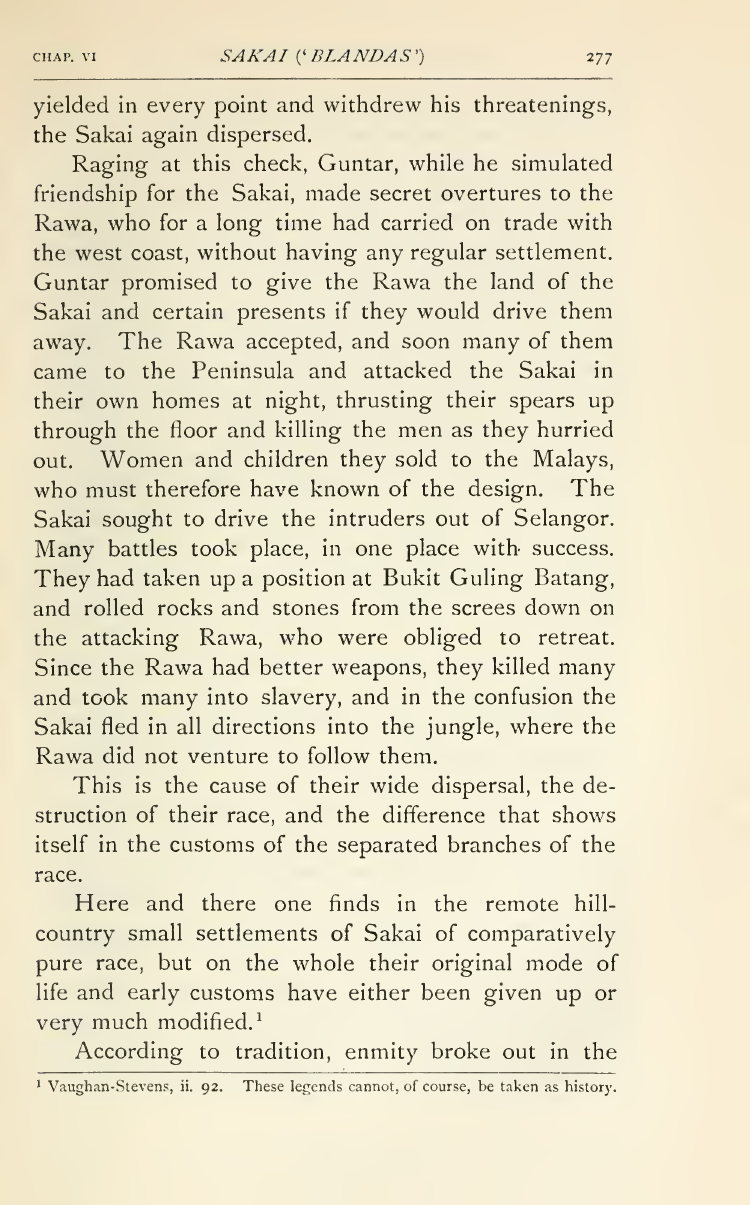
In 1906, Skeat and Blagden published the two-volume Pagan Races of the Malay Peninsula. The title and language of this work carry the biases of the colonial era; it cannot be treated as an innocent truth machine. Yet it preserved a great deal of material collected at the time, and it preserved something that the colonial authors were willing to acknowledge: that the Orang Asli had been hunted, enslaved, and plundered. 3,4
One passage recounts how the Rawa attacked Sakai houses at night. Men who rushed out were killed; women and children were sold to Malays. The editors themselves caution in a footnote that these legends cannot be taken straightforwardly as history. That caution must be retained. 3,1
Yet one cannot discard the whole account simply because it is "legend."
Because on the other side, Heikkila recorded Semai place names and whetstones in the twenty-first century; and Nowak and Muntil, in the folklore and ethnohistory of the Btsisi'/Mah Meri, found the same structure: armed outsiders entering, land seized, children enslaved, family members killed. 1,2
Different periods, different authors, different communities — they did not leave identical stories.
But they point towards the same shadow.
More than a hundred women and girls#
In the article by Nowak and Muntil, there is a passage drawn from a record by J. R. Logan dating to 1847.
Logan states that the Rawa attacked the Mintira / Mantra, killing many men in several places, and took more than a hundred women and girls to Pahang, where they were sold into slavery. 2,1
Pause here.
"More than a hundred" is not a figure to be deployed for inflammatory purposes. It comes from Logan's nineteenth-century record, transmitted through Nowak and Muntil; what we read today is not a list written by the victims themselves. 2,4
But neither is it empty rhetoric.
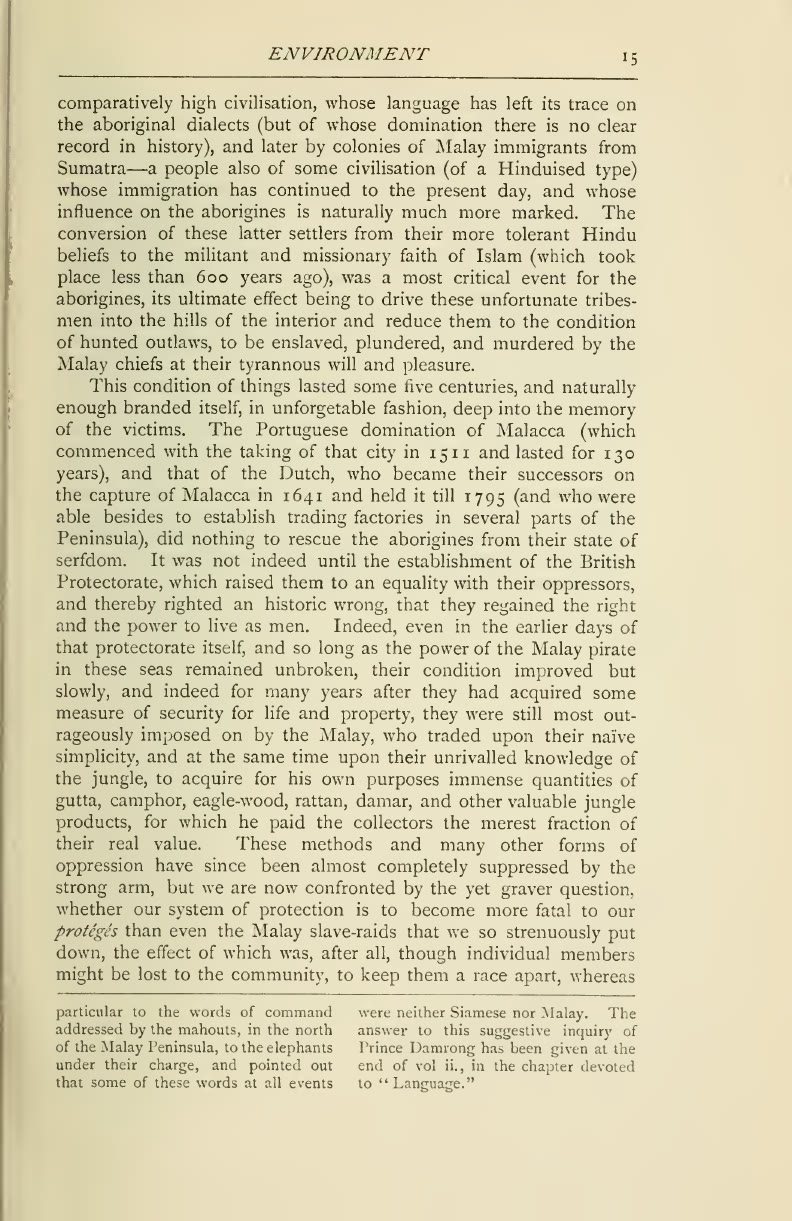
Because when Baer assembled the British colonial-era materials, he noted that in early British Malaya, Malay slave raiding of the Orang Asli was a persistent concern; the same body of materials repeatedly shows that, however often British authors denigrated the Orang Asli, they could not entirely avoid this history of violence. 4,3
This is the most painful aspect of this kind of history.
The victims left no register.
Those who recorded them so often looked down upon them.
We can only, carefully, recover these people from between biased pages and traumatised place names.
The most specific royal lead#
One record must be presented separately here — and its limits must be stated clearly.
Nowak and Muntil write that Andaya and Andaya, in A History of Malaysia, mention that as late as the end of the nineteenth century, Sultan Abdul Samad of Selangor still kept Orang Asli slaves. Nowak and Muntil add that the original source does not specify which Orang Asli community these slaves came from; since the Btsisi'/Mah Meri lived near Bukit Jugra, they suggest it is possible that some were Btsisi'. 2,4
This is a significant lead, because it names a specific royal household.
But it must not be written beyond its limits.
What it can establish is this: academic literature records that the household of Sultan Abdul Samad in the late nineteenth century kept Orang Asli slaves.
What it cannot establish is that Sultan Abdul Samad personally ordered any particular raid, nor that those slaves were necessarily Btsisi'. The available sources do not currently provide sufficient evidence for either conclusion.
This is the most important discipline in historical writing: the sentence stops where the evidence stops.
The word "Sakai" is itself testimony#
In Malaysia today, "Sakai" is a derogatory term.
This article therefore uses it only in historical context, and notes each time that it is a classification from old sources — not this site's own term for the Orang Asli.
Nowak and Muntil's annotations are clear: traditional Malays used Sakai to refer to the Orang Asli; in the modern context it carries the pejorative meaning of "slave," while its earlier sense may have been dependent or subject peoples — those under the authority or patronage of another. 2,3
This is a convenient point to explain an English term: vassal.
A vassal is not a slave.
A slave is someone deprived of personal freedom, who can be bought, sold, owned, or compelled to labour. A vassal is closer to a subject, dependent, or tributary: one who may still retain their own chief, family, and way of life, but who politically recognises a more powerful ruler and bears obligations of tribute, service, escort, military support, and the collection of forest products. In the Malay world, the relationship between certain Orang Laut and Orang Asli communities and royal authority sometimes more closely resembled a vassal or client relationship; but when this dependency slid towards abduction, sale, and forced labour, it was no longer an ordinary relationship of subjection. 2,3
A word shifting from "dependent" to "slave" is not a minor change in a dictionary.
It describes a change in the relationship itself.
A trading relationship can become a relationship of control.
A relationship of control can become a relationship of raiding.
And a raiding relationship will eventually be preserved in the word one person uses to insult another.
Who should remember#
Here lies a difficulty.
If we write only "Rawa, Mandailing, Batak, local chiefs," readers may feel that this has nothing to do with Malaysia today.
If we write directly that "Malays enslaved the indigenous peoples," we compress a complex history into an accusation against an entire ethnicity.
Neither approach is honest enough.
The more accurate formulation is this: these raiders belonged to the power, trade, and identity networks of the Malay world at the time; certain groups who were later classified as or who identified as Malay did participate in the slave raiding of the Orang Asli. At the same time, trade, alliance, intermarriage, refuge, and assimilation also existed. History is not a single line. 1,2
But complexity does not mean the right to forget.
We cannot delete the people who were taken away from our sentences simply because we want unity today.
True unity does not mean asking the victims to be silent.
True unity means that as a nation we are willing to acknowledge: some people's ancestors did not enter history by invitation. They were hunted, sold, and driven deeper into the mountains — and that is how they disappeared from the mainstream narrative. 1,4
No video — and that too is part of the evidence#
This article contains no video.
Not because none was sought.
But because there is no contemporaneous footage of nineteenth-century slave raids. Inserting a modern documentary about the Orang Asli would only mislead readers into thinking that a camera can prove what it cannot.
This article therefore uses only three categories of image: public-domain pages from old books, a schematic map redrawn from the text of a scholarly article, and photographs that show the Orang Asli as real, present people.
The old book pages do not prove that "every detail is beyond dispute." They prove that this material genuinely appears in early British writing.
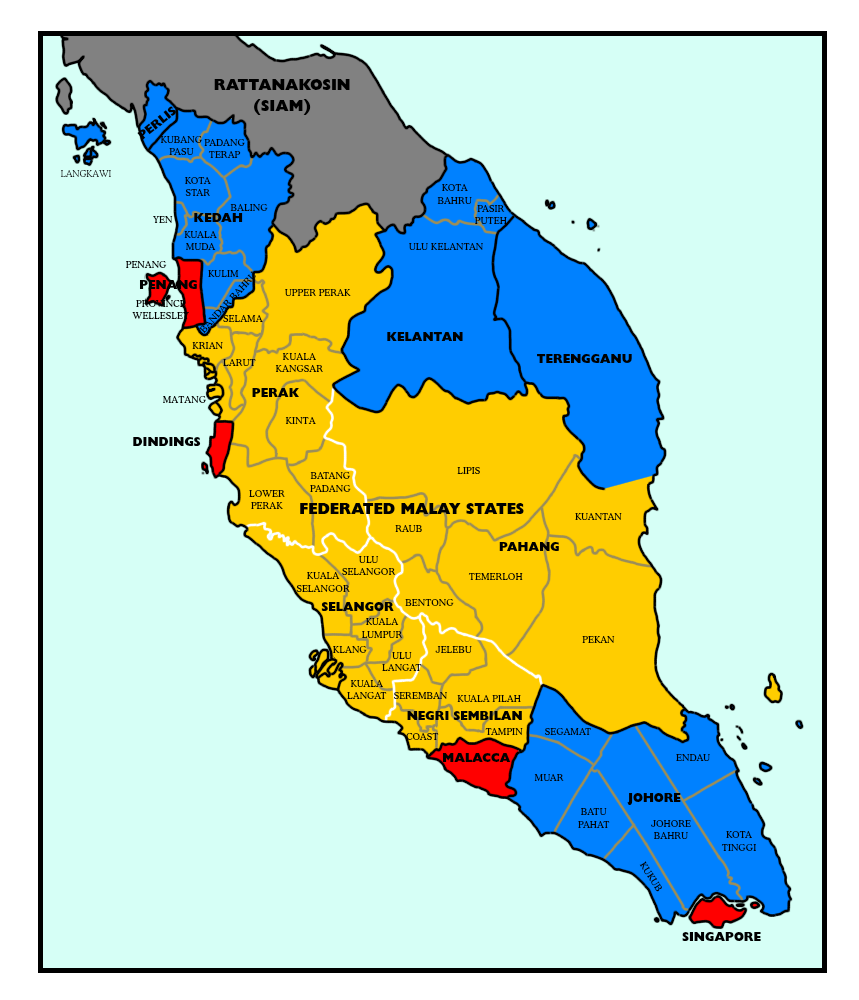
The map does not prove precise boundaries. It proves that place names and routes constitute a spatial memory.
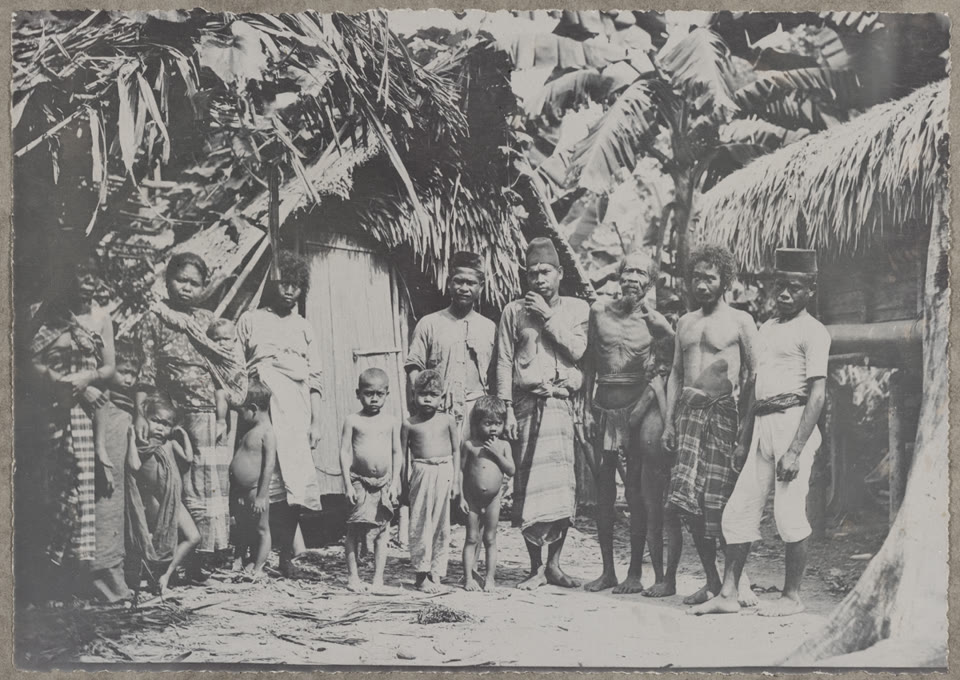
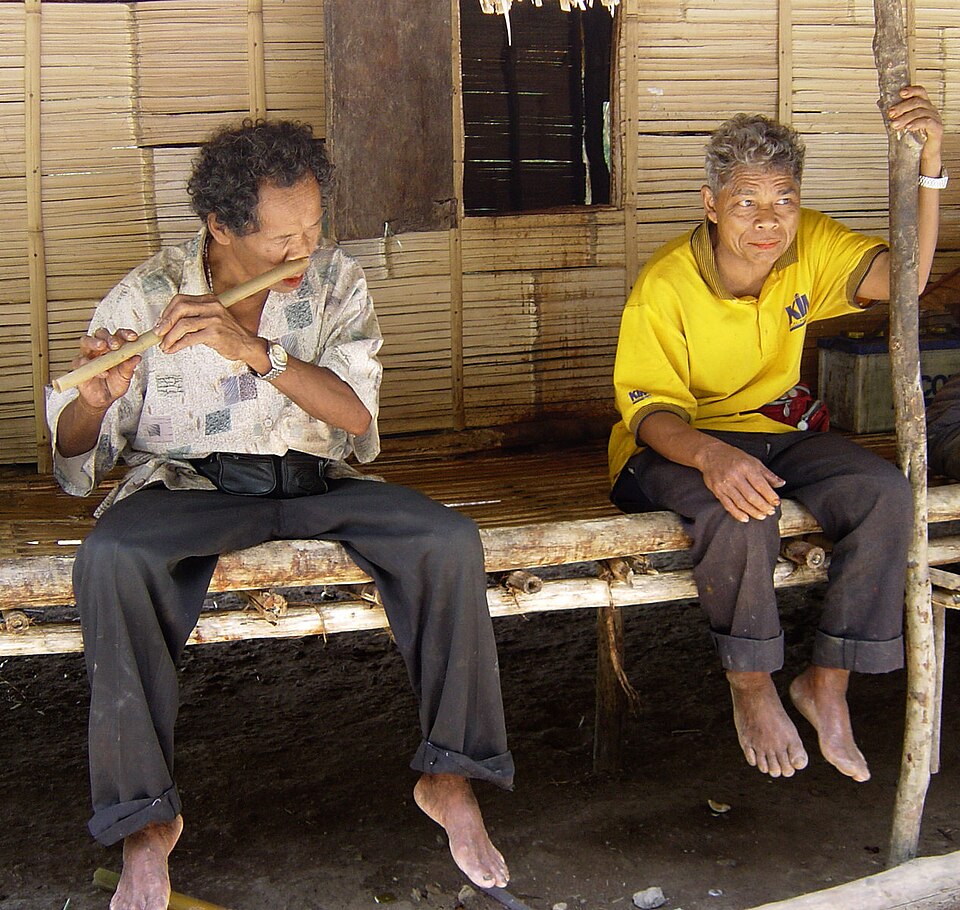
The photographs remind us that these are people who are still alive today — not a matter of the past tense.
The evidence that truly bears weight is not in any video.
It is in the scholarly articles, the old ethnographies, the place names, the whetstones, and the words passed down by Orang Asli elders. 1,3,2,4
The evidentiary limits of this article#
Prak Sangkiil and Semai place names rely principally on Heikkila 2016. This is the most important scholarly pillar of the article, because it reads oral history, place names, and specific locations together. 1,2
Colonial records rely principally on Skeat & Blagden 1906 and Baer's compilation. Skeat & Blagden's language carries colonial racial assumptions; this article draws only on their documentary layer and does not adopt their derogatory terms or evolutionary judgements. 3,4
Btsisi'/Mah Meri and Mantra/Temuan memory relies principally on Nowak & Muntil 2004. The old records cited therein — Logan, Letessier, Wilkinson and others — are used in this article as "old records organised by scholars"; they are not presented as first-hand testimony written by the victims themselves. 2,4
The Sultan Abdul Samad reference establishes only that academic literature records his household as keeping Orang Asli slaves; this article does not expand it into the claim that "he personally organised slave raids." As to which community these slaves came from, Nowak and Muntil explicitly note that the original record does not specify; the identification of Btsisi' is a possible inference based on geographical proximity only. 2,4
Endicott 1983 is one of the most frequently cited core studies on this subject, but the full text was not obtained in this research round. This article lists only its bibliographic information and research context in the sources table, and does not allow it to bear independent evidentiary weight. 5,1
Image limits must be stated plainly: this article contains no photographs of slave raids in progress. The 1906 book pages prove only that these accounts appear in early British writing; the self-drawn map only helps readers understand the routes and place names in Heikkila's article; old photographs prove only that the Orang Asli were photographed and classified in the colonial era; contemporary photographs prove only that the culture is still present. No single image can independently prove any particular raiding event.
This article carries sensitive: true. Before publication, every sentence touching on Malays, the Rawa, Mandailing, Batak, Orang Asli, Islam, slave raiding, and ethnic identity must be reviewed by an editor line by line.
The next article is not a census. The next article stays in the forest a little longer — to record some people who almost survived only as place names.
Sources 5 Every important claim here can be checked. Open it and see.
Do not trust this site. Check it — every source below is clickable.
This site is written with AI assistance. Please check us.
AI can invent citations that look completely convincing — a real author's name, a plausible title, a sensible year, for a work that does not exist. This is not a theoretical risk; it is a known failure mode. That is why every source on this site is clickable. If a reference cannot be found anywhere, it may well not exist — and we want to know.
How to check us →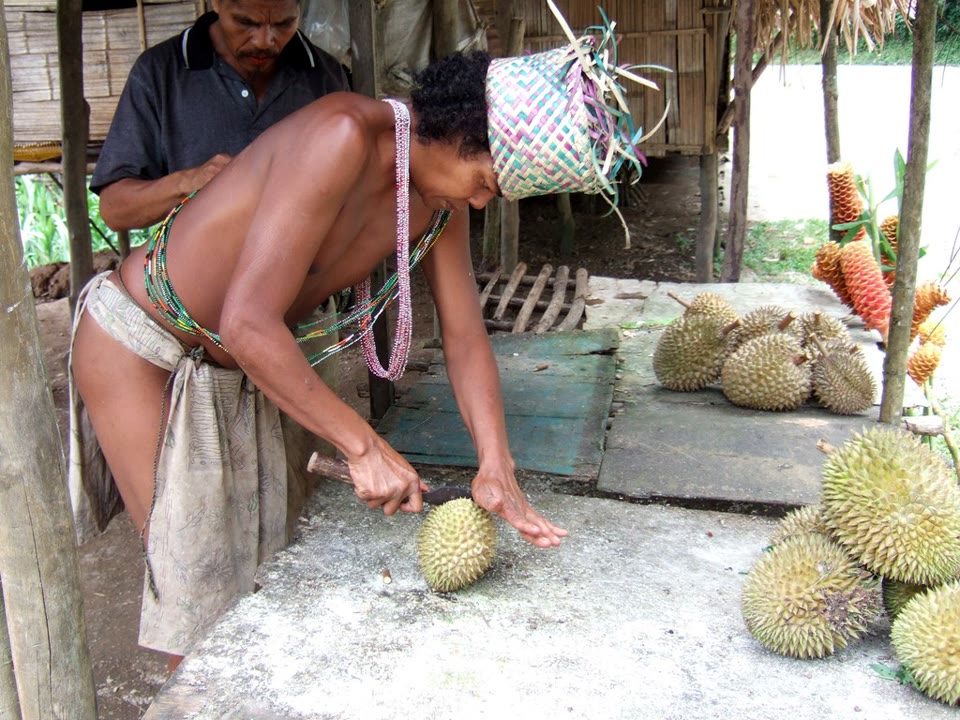
Reader Comments
Be the first to share your thoughts.